TheSearchGuru.com logo

news

7.8.08
Leslie Carruthers will be speaking to the Women in Business group at 8 A.M. on July 8th, 2008.

Nonmembers are welcome to attend – please RSVP via email or phone 216-337-2106.

6.10.08

Leslie Carruthers will participate in a panel discussion at the upcoming Women Entrepreneur Open House sponsored by Norma Rist, a long time proponent of women business owners and president of Athena International. The event is Tuesday, June 10 at the Women’s City Club in Akron. Cost is $5 to BoardRoom Group members and $10 for all others. RSVP to norma@normarist.com. See you there!

Read more info about this event

6.6.08

Leslie Carruthers of The Search Guru was quoted in the Cleveland Plain Dealer regarding Business and Blogging.

Click here to read the article

> More news

Come grow with The Search Guru

Key difference between a B2B and B2C marketing for search.

What do you think are the key difference between a B2B and B2C marketing for search? What do B2B search marketers need to do differently?

The key differences between B2B and B2C marketing are the lead time and approval layers.

In B2C web site marketing, there is a normally a short lead time of anywhere from a minute to a day. Consumers may only need, at the most, to consult with a spouse or parent about a purchase before making that purchase. Sometimes they do not even need to do that. They simply can purchase on impulse. In the B2B world, the idea of an impulse buy is almost non-existent. There is normally a chain of command that needs to be followed before a purchase can be completed. This increases the lead time exponentially, depending upon how many levels the purchase must go through to be approved.

A major difference between a B2B and B2C marketing online is that the B2B websites need to keep that chain of command in mind. They need to provide information that will answer each of the questions each perspective layer in the command needs to answer. For example, let’s say that an office manager has decided that she wants to find a new place to buy pens. In the office manager’s mind, she is simply thinking of the place that has a good price on pens and may offer her some perk for her for doing business with them. But she will most likely need to bring the decision to accounting on some level to see if the payment required by accounting is acceptable. While she may not need to actually get permission from accounting, this is still a layer. She will also, most likely, need to get final approval from a superior to switch pen companies. The superior may be concerned with the service the pen company will provide, the speed of delivery and the reputation of the pen company.

Making sure that B2B websites address all the questions (and desires) that all layers in the chain may have helps ensure that they will purchase your product. If the office manager sees no perk for her or that you are not the lowest price, she may never bring your company up to her superior. If payment options are not clearly marked out, the office manager may skip over it since she will not be able to answer accounting’s questions. If there is no mention of the quality of the company, her superior may reject the request to switch rather than go through the hassle without knowing the level of service they will be getting.

What advice would you give to B2B websites to help them improve the ROI of their paid search marketing campaigns?

To improve the ROI of search marketing, remember the difference between a B2B and B2C marketing online is the longer lead time and multi layer approval that this process entails. Many analytic programs will, by default, track conversion on a linear level. In other words, they will only track conversions if someone clicks on an ad and goes within that visit to the conversion point. So, a B2B paid search marketer should spend time figuring out their lead time (between a first visit and a conversion) and then use an analytic program that tracks later conversions that may have begun with a click on a paid ad weeks – or even months – earlier.

As another strategy, tracking offline conversions can help you find other conversions that would not typically figure into an analytics programs calculation of your ROI. These ROI factors are not as obvious as the ones discussed above, but, especially for B2B, identifying and accounting for them helps you spend your advertising dollars more effectively. An example of tracking offline conversions would be that you might use a different phone number on the site than your usual one and would be able to track how many calls came through that number. Another offline tracking tactic would be to provide an coupon on the website for offline purchases and see how many people use that coupon.

Also, keeping in mind the layers discussed above, B2B websites should focus on micro conversion points, such as gathering contact information from a prospective client or supplying branded white papers with information that will help the visitor with his or her own decision-making process as well as the decision-making processes of others in the chain. Gathering contact info allows for other non-expensive contact points and white papers keep your company’s name in front of a potential customer.

What advice would you give to B2B websites to help them improve the ROI of their search engine optimization (SEO) efforts?

Micro conversions can also help with the ROI of an SEO campaign. Also, be sure to create content for your site that focuses on all the layers for your products’ approval chain, making sure to include the appropriate language (effective keywords) for each of those different purchase points.

Another one of the similarities between B2B and B2C marketing when selling online is that you must create text that is effectively optimized with the most compelling and carefully targeted keywords possible, so that potential buyers find your site; can effectively navigate their way through your products/services; and can arrive at a purchasing decision that satisfies their wants and needs.

With B2C web site marketing, your business sells directly to consumers and your potential customers are usually buying products/services for themselves, or for close friends and family members. Therefore, you should hone in on the benefits of the product or service for an individual or a family – money saved, comfort gained, beauty enjoyed, and convenience delivered and so forth – using keywords that a non-expert might use.

One difference between a B2B and B2C web site marketing when selling is you must contend with different entities within a business. For example, the purchasing department may be visiting your site to review products for the marketing department, the IT department or one of numerous other segments of their business.

Moreover, different departments have different expectations for products and services. So, for example, if you’re selling software for marketing departments to use, the marketing staff will want to see how effective your software is to use, while the finance department wants good value for their dollar; and the IT department wants to know how easily the software can be integrated into their overall system.

The challenge for search marketers, then, is to identify who in the business is buying their products online; what level of understanding they have about the product; the jargon that they might use to find your product (which can be quite different from YOUR in-house/industry jargon); and the benefits that their business needs to receive from your products/services. Plus, the person browsing your website may not be the person who has the financial authority to okay the purchase, so you must write copy to persuade different employees/departments along the buying cycle.

When developing the overall copywriting/search marketing strategy, keep the results gleaned from your keyword research at the forefront at all times. These are your cues as to how your prospects are thinking, searching – and, ultimately, buying.

Finally, another one of the similarities between B2B and B2C web site marketing is that it’s important not to get so caught up in the technical details of writing for search engines that you forget to craft a uniquely compelling message written to your precise target market. Speak to the person you wish to reach (Saves your company 40%) versus extolling the virtues of your own company (We cut prices).

Sign up for free
SEO strategy
e-newsletter

E-Mail:

Sign up for The Search Guru e-newsletter and get a FREE 14 page whitepaper on how your designer can make your website more search engine friendly.


Client Testimonials

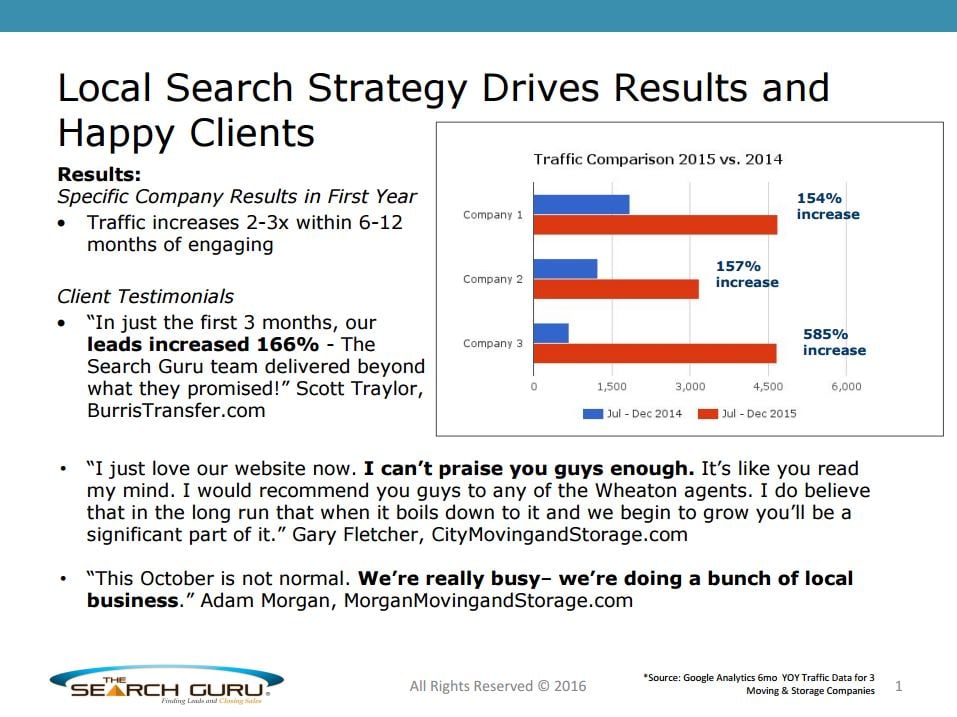
We engaged with The Search Guru to optimize our website, DentalWorks.com, and the results have been outstanding. Their expertise in a variety of areas has enabled DentalCare Partners to create a comprehensive search engine marketing strategy that includes organic search, pay-per-click advertising, blogs and more. The entire team at The Search Guru has demonstrated their leadership and collaboration skills throughout the project, as well as a genuine interest in understanding our business. We have seen dramatic increases in site traffic and conversion rates, and most importantly, we are more accessible to our prospective patients and the entire online community.

Jennifer Kalan, Manager, Application Development, DentalCare Partners, Inc.

Schedule your
free gift session
Schedule your free SEO gift session today!today!


• See your site through the eyes of the search engine spiders.
• Get expert, actionable feedback to make your site sell harder.

AdWords Qualified Professional